



Today is 21 Azar/ December the 12th.
It has been 80 years since the establishment of the Azerbaijan Democratic Party, founded under the leadership of Seyid Jafar Pishavari, which led the struggle of the people of South Azerbaijan for their national-democratic rights and succeeded, on December 12, 1945 (21 Azar), in opening the National Assembly of Azerbaijan and forming the National Government of Azerbaijan. This party carried out great and invaluable reforms in all spheres of national culture and the economy for the benefit, freedom, and welfare of the people. The party remains alive today; it continues its activities and maintains its Central Committee, press organ, and official website.
The study and analysis of the political activities of the Azerbaijan Democratic Party (ADP), established on September 3, 1945, in Tabriz, remains extremely important today for guiding the national-democratic movement of the peoples of Iran—including Azerbaijanis—in the right direction, choosing correct slogans, and determining a proper course of action. This is because the political, economic, and social conditions that gave rise to the ADP still exist within Iran today.

The 21 Azar movement instilled and affirmed a sense of national identity among Azerbaijanis in Iran, strengthened their national consciousness, and confirmed the possibility—within a multinational state like Iran—of attaining national-cultural and even political autonomy, and achieving a federal state structure. The reforms implemented by the National Government under the leadership of the ADP in a very short period created strong faith in national statehood, demonstrated its feasibility, its path and form, and set an example of “Azerbaijanism” for other nations and peoples living throughout multinational Iran.
The peoples of Iran saw in the 21 Azar movement a firm and unshakeable support, viewing it as a foundation for their own struggle. At that time, the Iranian press wrote: “Pishavari says that as long as Azerbaijan stands, it will be impossible to strangle the freedom-lovers of Iran.”

A brief overview of the laws passed by the Azerbaijan National Assembly (NA) and the reform measures of the Azerbaijan National Government (ANG):
- 08.04.1946 — Law on nationalizing mines, all underground wealth, and natural forests, placing them under state control.
- The law dated 08.05.1946 stated: “All government employees must wear the national insignia.”
- 120 large, medium, and small industrial enterprises were restored, constructed, and put into operation.
- The National Assembly adopted a 52-article law to improve the conditions and fundamentally reorganize the working environment of laborers and artisans.
- For the first time in history, women were granted equal rights with men.
- The ANG carried out radical land reform. 437 land plots belonging to “enemies of the people” (4.7% of South Azerbaijan’s land fund) were confiscated, and together with 373 state-owned village lands (4% of the land fund), were distributed free of charge among 1 million peasants (375,000 peasant families).
- A 22-article law on the division of agricultural income between landlords and peasants was enacted; all peasants were granted equal rights to use communal lands; peasants were permanently exempted from water fees, pasture fees, fuel-gathering fees, and similar dues; all debts owed by peasants to landlords, the state, usurers, and others were cancelled; all forms of forced labor were abolished.
- A “Agricultural Bank” was established.
- Peasants were given full ownership—free of charge—of their gardens, threshing grounds, home plots, and all their agricultural lands.
- To meet financial needs, one million tomans of state-backed temporary treasury notes were issued.
- The ANG established 19 branches of the National Bank of Azerbaijan.
- 5 million tomans were allocated to the Agricultural Bank.
- A law was enacted to control all imports and exports to and from Azerbaijan—although the ANG did not yet have the ability to conduct foreign trade.
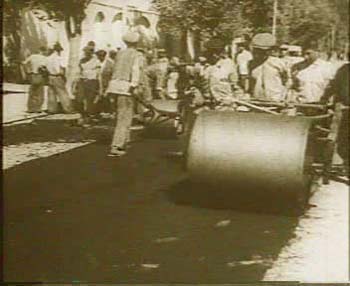
- With public participation, highways were built, bridges constructed, schools, hospitals, pharmacies, maternity homes, nurseries, kindergartens, orphanages, clubs, and other public institutions were built or restored; asphalt roads were laid; power stations were built; radio networks expanded; administrative buildings were built or enlarged; water lines were installed or repaired; flood-control embankments were constructed; and numerous other major public improvements were undertaken.
- By decision of January 6, 1946, the Azerbaijani language was declared the official language of government and education in Azerbaijan. All administration, communication, correspondence, and instruction in all schools were conducted in Azerbaijani (primary schools exclusively in the mother tongue; afterwards, Persian could also be taught). All official announcements, law drafts, decrees, judicial proceedings, and public meetings were conducted in Azerbaijani.
- 3800 literacy-elimination courses were opened across Azerbaijan.
- More than 2000 village schools and nearly 500 city schools were opened.
- The ANG declared education free of charge.
- On January 12, 1946, a law was passed to support orphaned and homeless children at government expense, including their education and upbringing.
- On March 7, 1946, a three-year technical school was opened in Tabriz to train railway specialists (mechanics, drivers, track construction, and communications).
- A four-month agricultural training course was opened in Tabriz.
- Three-month political courses and a law school were opened in Tabriz to train party and government cadres in politics, judiciary, and administration.
- Short-term medical training schools, a three-year feldsher school, and a three-year midwifery school were opened.
- On December 21, 1945, the National Assembly passed a law establishing the People’s Army.
- On March 15, 1946, a secondary military school was opened in Tabriz.
- On February 28, 1946, special police training courses were opened under the Tabriz Department of Internal Affairs.
- On June 12, 1946, the “Azerbaijan” University was opened with three faculties: medicine, agriculture, and pedagogy (including physics, chemistry, history, language, literature, philosophy, law, mathematics, and natural sciences).
- In just one year, about 50 newspapers and journals were published, along with many textbooks and books in political, historical, and literary fields. Newspapers such as Azerbaijan, Azad Millat, Yeni Sharq, Qalaba, Cövdət, Urmiya, Cavanlar, Azər, and journals such as Azerbaijan Star, Assembly of Poets, Maarif, Vatan, Fədai, Demokrat, Günəş were issued.
- The “Behzad” Museum of Arts and Higher School of Fine Arts were opened in Tabriz, with departments of painting, sculpture, engraving, and music, educating 300 young students.
- Azerbaijan Radio Station was opened, and a Radio Information Committee was created.
- Monuments to Sattarkhan, Bagirkhan, and Sheikh Mohammad Khiyabani were erected.
- For the restoration of old buildings, construction of new theatres and cinemas, and repair of cultural monuments, 14,022,300 tomans were allocated by decision of May 24, 1946 (the total budget was 64 million tomans).
- On February 6, 1946, the ANG awarded the “21 Azar” medal to 20,000 participants of the national-democratic movement.
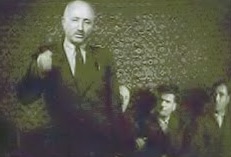
- In 1946, on the first anniversary of the ADP’s founding, the Sattarkhan Order was established; on September 3, 1946, after Pishavari’s speech at the Tabriz State Theatre, he personally awarded the order to 10 individuals active in the national-democratic movement.
The above-mentioned reforms of the ANG reflected the direct desires and aspirations of the masses, and therefore quickly resonated throughout the Near and Middle East, especially in other regions of Iran. The 21 Azar movement represents one of the highest peaks in the revolutionary history of our people, and its influence was vast.
Long live Azerbaijan!
Long live unity, struggle, and victory!
December 12, 2025 / 21 Azar 1404
Samad Bayramzade

Head of the South Azerbaijan Branch of the Azerbaijan National Academy of Sciences.